
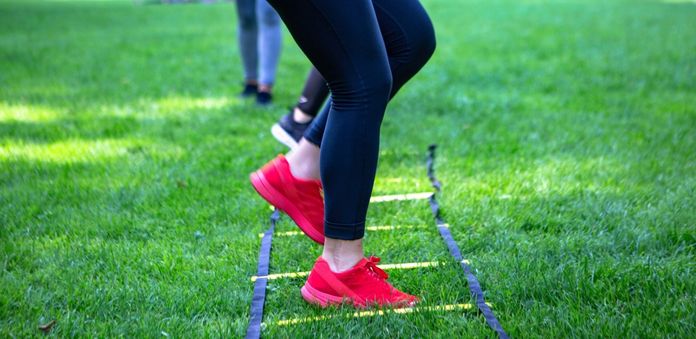

Agility Ladder Movement Demo
Boost Coordination, Speed & Stability with Every Step
At Health Plus Physical Therapy & Rehabilitation Center, we emphasize exercises that build real-world coordination, control, and balance. One of the simplest yet most effective tools we use for this is the agility ladder. It’s not just for athletes — it’s for anyone looking to improve stability, reaction time, and confidence in movement.
What Is an Agility Ladder?
An agility ladder is a lightweight training ladder placed on the floor, used to perform precise stepping or hopping drills. These movements help retrain your body’s coordination and responsiveness, improving how efficiently your muscles and nerves communicate — a key part of rehabilitation and performance training.
Why We Use Agility Ladder Drills
Agility ladder movements are designed to:
– Enhance coordination and balance
– Increase lower-body strength and foot speed
– Improve dynamic stability during quick movements
– Reduce risk of falls and movement-related injuries
– Boost confidence in motion after injury or surgery
For many of our patients, this exercise helps restore functional mobility, whether recovering from a sports injury or regaining confidence after joint pain or surgery.
Movement Demonstration: Common Drills
Our therapists often guide patients through progressive drills, starting slow and building rhythm and control.
1. One-Step Drill
Step one foot into each square, alternating right and left. Focus on posture, soft landings, and maintaining a steady rhythm.
2. Two-In, Two-Out Drill
Step both feet into one square, then out to the sides. This lateral pattern builds hip control and quickness — great for re-training dynamic balance.
3. Icky Shuffle (Zig-Zag)
A classic coordination drill: step one foot in, then the other, and move diagonally out. It challenges your ability to change direction while maintaining control.
4. In-Out Hop Drill
Hop both feet inside one square, then out to the sides. It improves plyometric control and ankle stability.
5. Backward Ladder Drill
Stepping or shuffling backward enhances balance, spatial awareness, and posterior chain activation — often undertrained yet crucial for daily movement safety.
Therapist Tips for Safe Practice
– Start Slow: Focus on technique before speed.
– Use Proper Footwear: Supportive shoes help protect ankles and knees.
– Stay Light: Land softly on the balls of your feet.
– Keep Eyes Forward: Train your body to move confidently without looking down.
– Progress Gradually: Add speed and complexity as stability improves.
Benefits You’ll Notice
– Improved balance and coordination
– Better movement confidence
– Enhanced joint stability
– Faster neuromuscular response
– Reduced fall risk and improved performance